
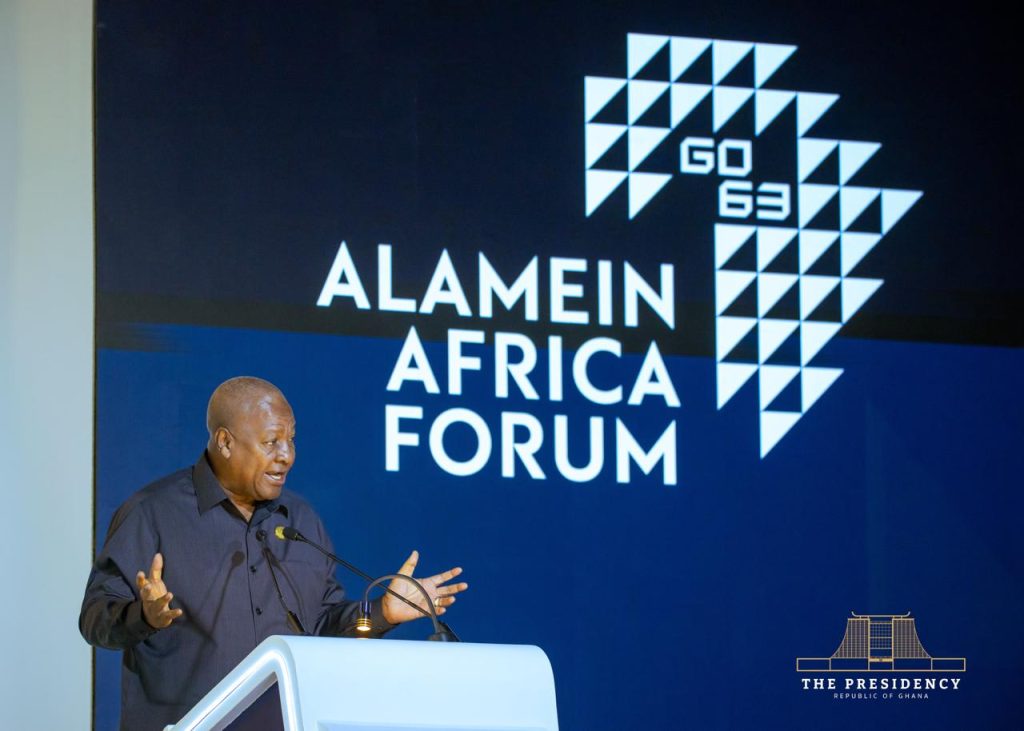
By H.E. John Dramani Mahama,
President of the Republic of Ghana
Your Excellencies, Heads of State and Government,
Honourable Ministers,
Officials from the African Union Commission,
Leaders from African industry and finance,
Distinguished guests.
I extend my sincere gratitude to President Abdel Fattah el-Sisi and the people of Egypt for their warm hospitality.
Eighty-four years ago, El Alamein was a tactical battlefield that reshaped the geopolitical order of the 20th century. Today, this vibrant city on Egypt’s Mediterranean coast stands as a symbol of transformation.
We gather to address a new challenge, using capital, industrial capacity, and political will. Our goal is health sovereignty and the economic and physical security of 1.4 billion Africans.
For decades, African Finance Ministers and global investors have made a fundamental error: they have treated health as a line-item cost—a social expenditure to be funded only when there is budget left over. Today, at the Alamein Africa Forum, we are moving beyond this outdated perspective.
Health is not a charitable cause; it is an investable, high-growth economic sector. It drives human capital, manufacturing, job creation, and macroeconomic stability.
The arithmetic is indisputable. The Copenhagen Consensus shows that a targeted package of basic emergency maternal and newborn care yields $87 in economic and social returns for every single dollar invested. The Lancet Commission established that falling mortality rates accounted for nearly a quarter of total income growth in developing economies in the early 2000s.
Investing in health strengthens our balance sheets rather than depleting resources.
Let us examine the market fundamentals. Africa imports over 70% of its pharmaceuticals and nearly 99% of its vaccines. Each year, tens of billions of dollars leave our economies to purchase medicines from abroad. Meanwhile, traditional donor assistance is declining. OECD projections indicate health aid will decrease by 29 to 46 percent compared to 2024 levels. This situation presents not only a crisis but also a significant market opportunity for domestic capital.
The business case for local pharmaceutical manufacturing is based on four key pillars:
– A Captured, Growing Market: Africa’s population will reach 2.5 billion by 2050. The demand for essential medicines, chronic disease management, and biologics is expanding exponentially.
– Import Substitution and Foreign Exchange Protection: Local capacity preserves foreign exchange reserves, stabilizes currencies, and shields economies from global supply disruptions.
– The AfCFTA Market Size: Under the African Continental Free Trade Area, an African pharmaceutical plant does not serve a single country of 10 or 30 million people; it serves a single, unified market of 1.4 billion consumers.
– The Africa CDC recently conducted its first pooled tender for maternal and child health products. By aggregating demand across borders, it achieved price reductions of 30% to 90% while ensuring African manufacturers won 50% of the product lines. Coordinated demand guarantees cash flows for producers.
To bankers, institutional investors, and industrial leaders, African pharmaceuticals represent a high-yield, resilient sector ready for investment. What does this economic transformation mean for the everyday African citizen?
It means health security. African mothers and children will no longer wait at the end of the global queue for life-saving vaccines or therapies during crises, as seen in COVID-19 and recent Ebola outbreaks.
It means High-Value Jobs. Africa currently faces a structural paradox. The WHO reports that while Africa lacks 6 million health workers, nearly 943,000 trained healthcare professionals and science graduates were unemployed in 2024. Local manufacturing generates jobs in R&D, clinical trials, engineering, and biotech, helping retain talent and employ youth.
It means affordability and dignity. Local production reduces logistics costs, removes intermediary margins, and delivers affordable, high-quality medicines directly to patients across Africa.
We do not need to look outside our continent for proof that this works. Look at our host, Egypt. It has systematically eliminated Hepatitis C, dropping prevalence from 10% to under 0.5%.
How did they do it? It did not rely on $84-per-course imported drugs. It negotiated technology transfers, built domestic production through champions like Pharco, treated 4 million citizens locally, and became the first country recognised by WHO on the path to elimination.
Look at Nigeria. The African Medical Centre of Excellence (AMCE) in Abuja, pioneered by Afreximbank and King’s College Hospital, is tackling the $6 billion lost every year to outbound medical tourism. By keeping high-end specialised care on the continent, we retain skills, wealth, and consumer confidence.
In Ghana, we are implementing the Accra Reset by expanding the National Health Insurance Scheme, introducing Free Primary Health Care, establishing the Ghana Medical Trust Fund, and empowering the Food and Drugs Authority and National Vaccine Institute to transition Ghana from a consumer to a producer of health products.
To turn these isolated successes into a continental ecosystem, we must eliminate regulatory and financial friction. Today, we present HINGE, the Health Investment and National Gateway Enabler. Developed with the African Medicines Agency, Institut Pasteur, and AfroChampions, HINGE is a digital platform that streamlines regulation, clinical validation, and commercialization into a unified process for innovators and investors.
Through the Accra Reset Presidential Council, we are deploying dedicated Task Forces and a Reform Interlock Observatory to track capital flows, enforce policy commitments, and dismantle non-tariff barriers across regional value chains.
Excellencies, Distinguished Guests, Ladies and Gentlemen,
Governments cannot and should not fund this transition alone. We need private capital, industrial developers, commercial banks, and sovereign funds to participate. Through initiatives like BUMBY (Business United for Mothers, Babies, and Youth), we are asking corporate Africa to integrate health investment directly into their capital allocation and corporate strategy.
Before I conclude, I would like to leave the panel and audience with three key questions:
To the Financiers: What specific de-risking instruments and blended finance structures do you need from governments to deploy patient capital into African pharmaceutical plants today?
To the Regulators: How quickly can we operationalise the African Medicines Agency to ensure a single drug approval opens the doors to all 54 AU member states?
To the Industrialists: What strategic partnerships do we need to move from basic packaging and fill-and-finish operations to full Active Pharmaceutical Ingredient (API) synthesis on African soil?
Let us stop treating health as a line-item expense.
Let us build factories, integrate supply chains, fund innovators, and secure our citizens’ future.
Thank you, and I look forward to an engaging, candid conversation.


